

Eighty-one years ago yesterday, a B-29 bomber dropped a bomb named Fat Man over the Japanese city of Nagasaki. The explosion instantly incinerated one square mile and 50,000 homes.
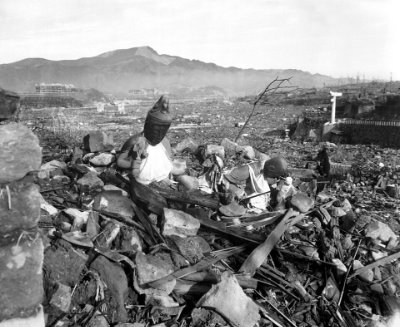
Cpl. Lynn P. Walker, Jr. (Marine Corps)
The Story
Tokyo began its conquest of the Pacific in the 1930s. By the summer of 1945, more than 30 million people had been killed across Asia, including 26 million civilians.
After the Allied victory over Nazi Germany, President Harry Truman began planning the invasion of Japan on July 16.
Previously, physicist Julius Robert Oppenheimer and his crew successfully detonated the first nuclear device in New Mexico on August 6, one week before the Soviets were scheduled to enter World War II in the Pacific.
You Might Not Know
Truman ordered the first atomic bomb dropped on Hiroshima to prevent the invasion and save American lives. He didn’t know about the effects of radiation. No one knew. It took the Japanese more than four hours to understand why that entire city had suddenly gone silent. The Emperor of Japan hoped the device was one of a kind. That wasn’t the case. On August 9, another atom bomb destroyed Nagasaki because the Japanese would not surrender even after Hiroshima on August 6.
Nagasaki was actually the backup (secondary) target for the August 9, 1945 atomic bomb mission. The primary target for the “Fat Man” mission flown by the B-29 Bockscar was the city of Kokura (now part of Kitakyushu, Japan).
Kokura was targeted because it housed one of the Imperial Japanese Army’s largest munitions arsenals. However, heavy clouds, smoke, and haze obscured the city after three unsuccessful bombing runs, forcing the aircraft to divert to Nagasaki.
Nine days later, Emperor Hirohito delivered a radio address announcing Japan’s final surrender. Said the emperor, “The enemy has begun to employ a new and most cruel bomb.” It was the first time most Japanese people had ever heard the emperor’s voice. He was considered a god.
In total, the atomic bombs killed 200,000 Japanese men, women, and children. The explosion also saved countless Americans who would have perished during the invasion of Japan.
Stalin declared war on Japan very late, on May 8, 1945, probably to get back at the US for not opening the Western Front sooner.