

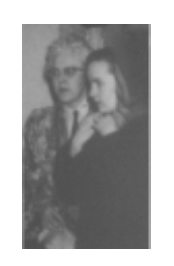
On March 8, 1954, 24-year-old Maine housewife Constance Fisher drowned her three children in a bathtub. Fisher was reportedly battling postpartum depression. She attempted suicide.
She was adopted and had experienced the deaths of people who cared for her. When she married Carl Fisher, she told people she married much too young. She needed a father more than a husband.
At one point before the murders, she tied a scarf around her daughter Debbie’s neck and tightened it. The child shrieked, and she stopped. That is when the help began. There was lots of help, some of it based on faulty logic. Nothing changed her condition.
The First Three Killings
Then she sought help and received extensive assistance. Her husband, Carl, followed all the advice he was given. However, while having resisted the urge to kill the children and Carl, she one day decided to kill them. She felt they would be better off in heaven.
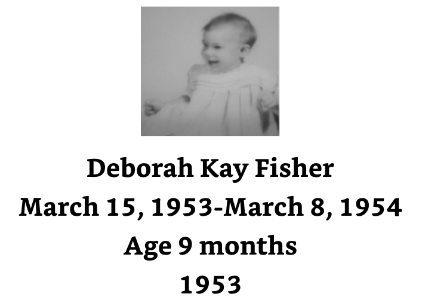
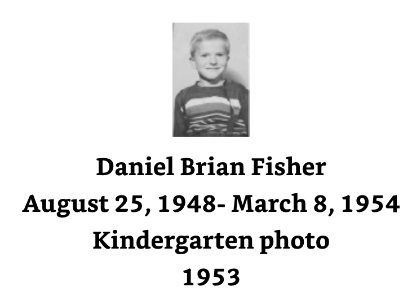
After planning the deaths, she drowned her son, Daniel, and daughter, Deborah, in the bathtub. Then she waited for Richard, Dickie, to come home so she could kill him too.
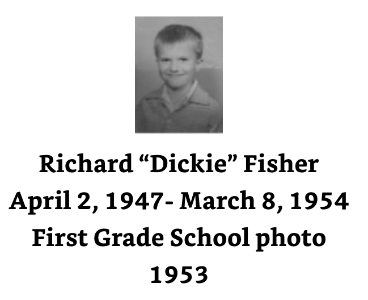
Her eldest, Dickie came home from kindergarten. His brother, Daniel, and sister, Debbie, were already dead.
Constance greeted him at the door. She took him in a long embrace, his last. She then told him to take off his clothes and that she would give him a warm bath. Once in the bath, she told him it would be over soon, and he would be in heaven. The six-year-old boy told her she didn’t have to do this. He fought her.
It took a day before she seemed to realize the enormity of what she had done. It was then that she cried inconsolably.
Sympathy led to her being spared prison and death. After spending only 5 years at the Augusta State Hospital, Constance Fisher was released from the institution. Constance Fisher was pronounced cured. Her release marked the beginning of a new era in the treatment of the mentally ill in America. The nation moved to phase out the large state-run mental hospitals.
When she entered the hospital, she said:
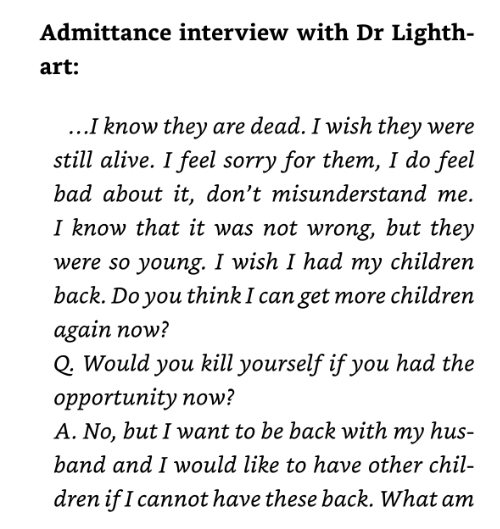
To another doctor at the asylum, she admitted she stole a gun to kill herself, but brought it back. She said she couldn’t bring herself to commit suicide. Then she found the solution. She would first kill her children and send them to heaven where they would be safe. After she murdered the children, she hoped it was just a bad nightmare. She too claimed she heard a voice telling her to do it. Constance thought she killed the children out of a desire for punishment or to escape responsibility. She described what we now know is bipolar disorder.
She reconciled with her husband and had three more children.
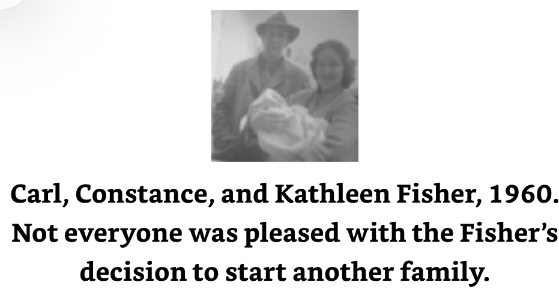
Fisher told the doctor upon her release that she was afraid it would happen again. He assured her she was cured. After she was released from the mental hospital, Carl, who had forgiven her, continued the marriage. They had three more children.
Tragically, Fisher snapped again in 1967 and drowned her three children in another bathtub. She was sent back to the hospital, which she never should have left. The youngest victim in her second killing spree was only nine months old.
There are striking similarities to the Lindsey Clancy case. In the Fisher case, she gave many warnings. She was given a great deal of help. If there was one thing that could have made a difference, it would have been for people to realize the danger and see that she was hospitalized for the remainder of her life.
Indeed, killing three helpless children should be a deal breaker. It should wake people up. People who do this are too dangerous to be free.
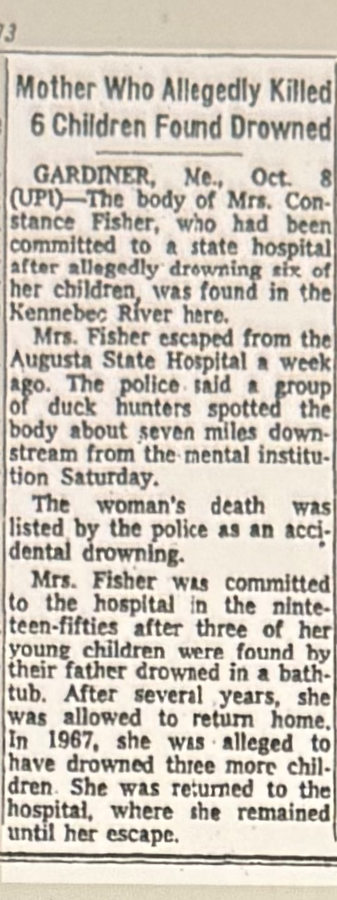
Finally, Fisher succeeded in killing herself.
The body of Mrs. Constance Fisher, who had been committed to a state hospital after allegedly drowning six of her children, was found in the Kennebec River here.
Mrs. Fisher escaped from the Augusta State Hospital a week ago. The police said a group of duck hunters spotted the body about seven miles downstream from the mental institution Saturday.
The woman’s death was listed by the police as an accidental drowning.
The New York Times reported her death on October 9, 1973:
Mrs. Fisher was committed to the hospital in the 1950s after three of her young children were found by their father drowned in a bathtub. After several years, she was allowed to return home. In 1967, she was alleged to have drowned three more children. Fisher was returned to the hospital, where she remained until her escape.
In a carefully detailed book on the tragedy, Bob Briggs wrote that God told her to do it and that they were safe in heaven. Constance Fisher also planned to kill her husband, Carl. But she couldn’t find a gun.
No one could believe it; when she was good, she was very good. Feelings in the public square ran the gamut, including sympathy. However, sympathy should not be confused with much-needed logic.
The Constance Fisher story was called the most bizarre murder story in the history of New England. We need more facilities for people who are criminally insane; facilities where they can live out their lives.
After the tragic losses, Carl Fisher carried profound grief for decades; he initially stood by his wife and had more children with her, visited her in psychiatric care until the sorrow became too heavy, and died in 1990. He was buried with Constance and his six children.
We didn’t know then what we know now. Whether it be an asylum or a prison, Lindsey Clancy must never be free again.