

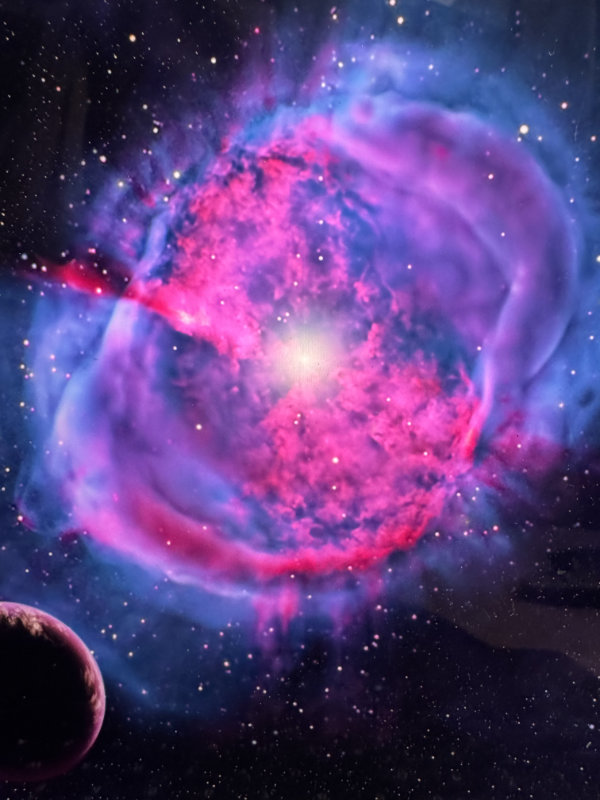
Scientists have identified several potentially habitable exoplanets, with recent breakthroughs revealing closer and more promising “super-Earths”. These worlds reside in the “Goldilocks zone”—the orbital sweet spot where temperatures allow liquid water to exist on the surface.
One in particular is called Earth’s next-door neighbor.
“This one’s exciting,” Paul Robertson of the University of California, Irvine, said in a statement on Tuesday, adding that “it’s one of our closest cosmic neighbors.”
“Twenty-five light-years sounds like a long way, but the Milky Way is about 100,000 light-years across, so in that respect it’s our next-door neighbor,” said Robertson, the lead author of a new study published in The Astrophysical Journal.
The “Goldilocks Zone”—formally known as the circumstellar habitable zone—is the region around a star where a planet’s distance is “just right” to maintain liquid water on its surface. If a planet is too close, water boils away; if too far, it freezes.
The exoplanet, called “GJ 3378b,” is approximately twice Earth’s size and lies within the Goldilocks zone, the region around a star where a planet’s surface temperature is just right to maintain liquid water.
“If you scale the Earth down to the size of an apple, its atmosphere would be about as thick as the skin of the apple,” said Robertson.
“That’s just enough to maintain the kinds of surface pressures where you can have liquid water,” he explained.
“It’s enough that there’ll be breathable air, and it provides maybe a little bit of protection from the harsh radiation environment of space.”
NASA has plans to construct the Habitable Worlds Observatory, which is slated to launch in the next 20 years or so.