

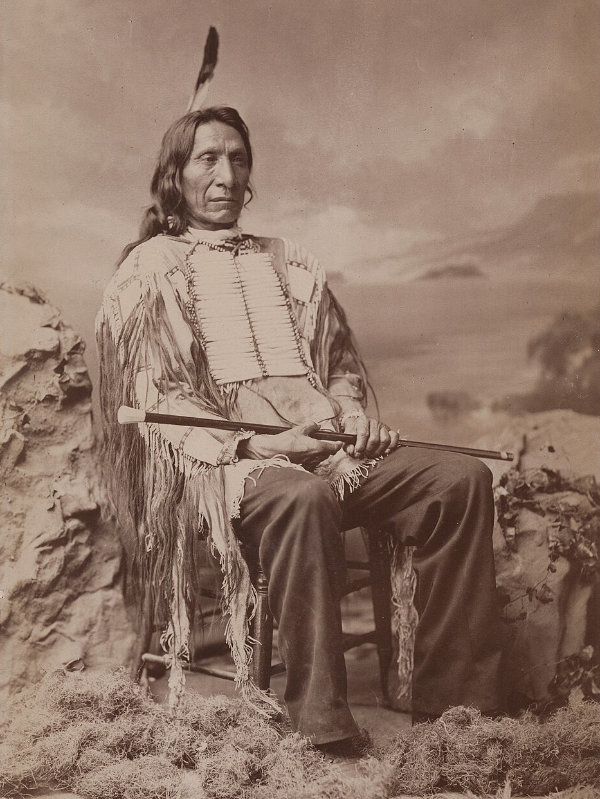
John Karl Hillers
Public domain, Wikimedia Commons
On June 25-26, 1876, 150 years ago, Chief Red Cloud led the Lakota and the Plains Indians in the Greasy Grass Battle, otherwise known as the Battle of the Little Bighorn or Custer’s Last Stand.
This is the story of Chief Red Cloud.
Chief Red Cloud was born in 1822 in modern-day Nebraska. The young Native American rose to prominence for his success on the battlefield. He was a brave and formidable leader. Chief Red Cloud was a leader of the Oglala Lakota from 1865 to 1909. He was one of the most capable Native American opponents whom the United States Army faced in the western territories. He led the Lakota to victory over the United States during Red Cloud’s War, establishing the Lakota as the only nation to defeat the United States on American soil.
Chief Red Cloud earned the nickname “Red Napoleon of the Plains.”
The Battle of Greasy Grass
Red Cloud soon realized individual warfare against the US Army would never succeed, so he united the tribes of the Lakota, Sioux, Jordan, Cheyenne, and others of the Great Plains.
He famously killed 81 soldiers in the Fetterman Fight. He won numerous battles, and finally, the Battle of the Little Bighorn, Montana. The Lakota and Arapaho had exclusive rights to the Dakota territory, but when gold was discovered, miners rushed in, and the government refused to force them out. Instead, the government sent the cavalry, including George Custer, to gather up the Indians and push them back onto reservations.
Lieutenant Colonel George Custer and 210 men of the 7th Cavalry were wiped out by thousands of Lakota, Northern Cheyenne, and Arapaho warriors led by Sitting Bull and Crazy Horse when Custer led his men onto sacred territory. He underestimated the size of the tribes.
Custer was a celebrated Union hero who was thought to have been reckless and ruthless during the Indian Wars, which led to his defeat at the Battle of the Greasy Grass.
The Treaties That Didn’t Last
In 1868, Red Cloud launched a successful guerrilla campaign that completely paralyzed American operations in the West. It was the first time that Indian forces had successfully defeated the US Army in a major battle to ensure lasting peace.
The two sides signed the Treaty of Fort Laramie. The agreement mandated that the USA abandon three forts and cease construction of new bases on Indian territory; however, the Americans quickly broke the treaty and continued to expand west.
In June 1870, Red Cloud and his team traveled to Washington, D.C. to meet President Ulysses S. Grant. No agreement was reached, but organized fighting stopped. The peace between the US and Red Cloud lasted two years. Tensions culminated in the massacre of Wounded Knee. There, the US Army killed more than 300 Indian men, women, and children. Troops then fought to disarm the tribes.
What You Might Not Know
Red Cloud was the most photographed American Indian of the nineteenth century. There are 128 known photographs picturing Red Cloud. He was first photographed in 1872 in Washington D.C. by Mathew Brady, just before meeting with President Grant. He was also among the Indians photographed by Edward S. Curtis.
He has been honored by the United States Postal Service with a 10¢ Great Americans series postage stamp.
In 2000, he was posthumously inducted into the Nebraska Hall of Fame.
In later years, Red Cloud converted to Catholicism. He supported the establishment of the Holy Rosary Mission on his reservation to convert tribal children. He died on December 10, 1909, at the age of 87. At 87 years old, he outlived nearly all the other major Lakota leaders of the Indian Wars. He was buried there in a cemetery that now bears his name.