

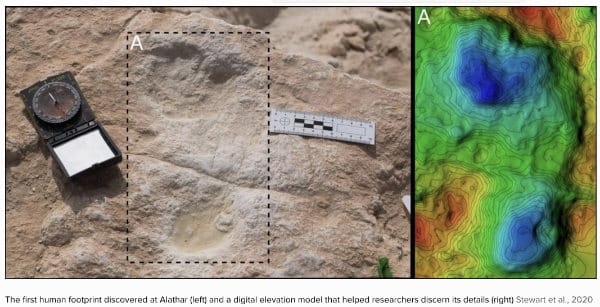
When populations move on, prints are left behind until they’re covered over. In the far, far older Burgess Shale event, some of the oldest organisms ever found were preserved intact because they likely fell into a mudslide and were killed instantly.
In their paper, scientists actually examine why that ancient mud was so special. They were found where they should not have been. They might have been the last people leaving to look for water and a warmer climate.
“An experimental study of modern human footprints in mud flats found that fine details were lost within 2 days and prints were rendered unrecognizable within four, and similar observations have been made for other non-hominin mammal tracks.”
That means their special, tiny batch of preserved footprints were made in unique conditions that also form a kind of “fingerprint” for pinning them all to the same timeframe. From there, scientists started to look at who made the footprints. Homo sapiens weren’t the only upright humanoid primate in the game, but the evidence, the scientists say, suggests we were the ones traipsing through the drying lakebed:
“Seven hominin footprints were confidently identified, and given the fossil and archeological evidence for the spread of H. sapiens into the Levant and Arabia during [the era 130,000 to 80,000 years ago] and absence of Homo neanderthalensis from the Levant at that time, we argue that H. sapiens was responsible for the tracks at Alathar. In addition, the size of the Alathar footprints is more consistent with those of early H. sapiens than H. neanderthalensis.”
These Homo sapiens could be the last ones on their way through a temperate place as an impending ice age descends. That would also explain why their tracks weren’t tracked over by another group, at least not before an entire fresh layer of sediment accumulated.
Imagine, possibly 120,000 years later, we know where and why they journeyed. We are on their journey with them.