

The Web of Basins
More than three kilometers below the Antarctic ice lies a giant geological structure: 30 basins, essentially large valleys carved into the bedrock, all connected to form a system as large as half of East Antarctica.
This is according to a new study.
The never-before-reported platform, which spreads out like a fan from a central point, contains some of the best subglacial formations, including the Wilkes and Aurora basins. It includes the basin holding Antarctica’s Lake Vostok, the largest subglacial lake formation on the planet.
This “fan” formed hundreds of millions of years ago, when Earth’s crust gradually opened as it rotated around a central point, like a fan being unfolded.
It resembles a hand with fingers spread out.
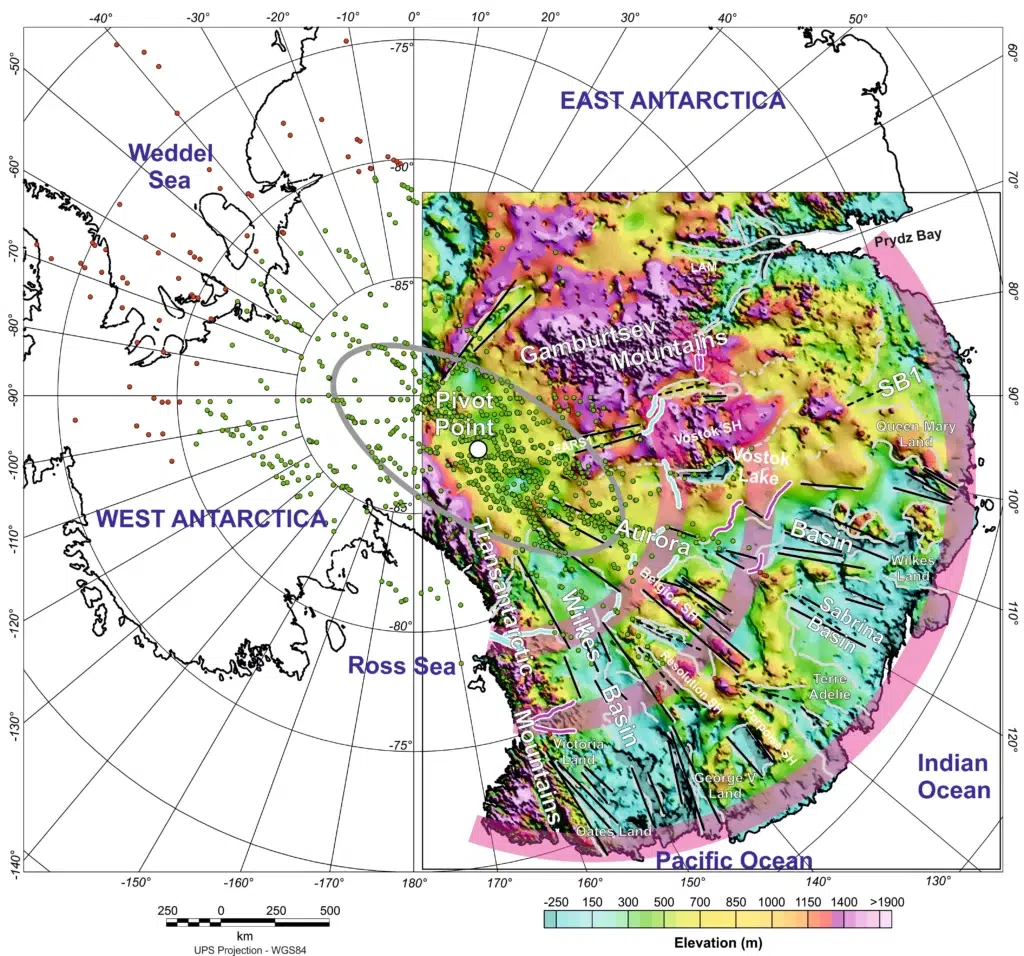
“This fan may be the result of a rotational movement of Earth’s crust that occurred before the breakup of the supercontinent Gondwana,” the scientists explain. This movement may have had massive consequences for the surface of the globe as we know it today.
To the west, it may have lifted the Gamburtsev Mountain Range. To the east, it may have rotated another mountain range to create the Transantarctic Mountains. Finally, to the north, this movement of Earth’s crust may have created the fracture line that ultimately guided the separation between Antarctica and Australia.