

Cleopatra was reviled despite her intelligence and charm. She was a woman from Egypt who was described as the evil temptress of Julius Caesar and Marc Antony. In the days of Cleopatra, the woman was blamed for what might have been male seductions or no seductions at all.
She bore sons for both men.
Plutarch has given us the most information on Cleopatra, but it’s hard to know what is true since he hated her.
Cleopatra’s Beauty
We do know what she looked like from surviving images. Perhaps more than beauty, the allure was her intelligence, personality and competence as a leader.
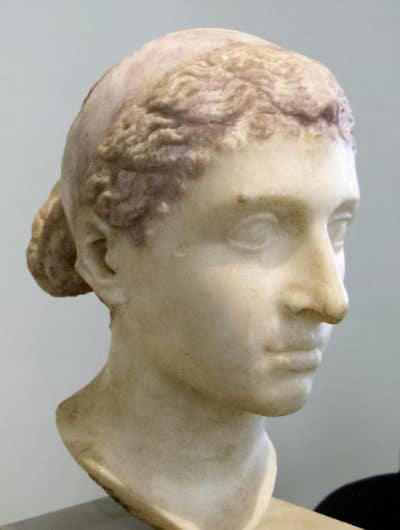
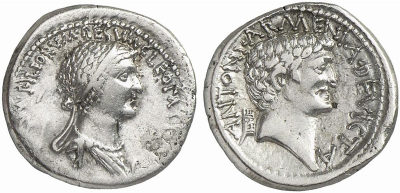
Images via Wikimedia Commons
Roman historian Dio Cassius described Cleopatra as “a woman of surpassing beauty,” but other modern historians have characterized her as less than exceptionally attractive. Still, they noted that her beauty was heralded and that her appearance was seductive. Greek biographer Plutarch, writing about a century after Cleopatra’s death, presented a less flattering picture: “For her beauty, as we are told, was in itself not altogether incomparable, nor such as to strike those who saw her.” Plutarch, however, also said Cleopatra had “irresistible charm,” a sweet voice, persuasiveness, and a stimulating presence.
No One Can Find Her Tomb
Despite her prominence, no one has been able to find her tomb. According to available records, she was buried with Marc Antony. That’s where the death and burial stories diverge.
Cleopatra reportedly died by suicide after her Roman lover, Mark Antony, was defeated by Octavian in the Battle of Actium in 31 B.C. As the story goes, Mark Antony fell on his own sword when he believed his beloved Cleopatra had been killed. Cleopatra, in turn, chose death over the humiliation of being paraded through Rome as a spoil of war.
Buried under the sea.
According to ancient Roman writers, Cleopatra and Mark Antony were buried together in Cleopatra’s mausoleum in Alexandria, which was still under construction at the time of their deaths. The challenge for archaeologists is that the ancient city was struck by a catastrophic earthquake and tsunami in A.D. 365, which buried its ruins under the sea.
“After that, there were various invasions and occupations of Alexandria that led to further destruction of historic buildings, so a lot of stuff has happened in Alexandria over the centuries,” says Jane Draycott, a professor of ancient history at the University of Glasgow. “It’s not really surprising that it’s so hard to find the ancient city under the modern city.”
In the 1990s, underwater archaeologists rediscovered the sunken royal quarter of Alexandria, where Cleopatra and the rest of the Ptolemaic Dynasty built their palaces and temples.
Decades of excavation failed to turn up the mausoleum. Cleopatra was born in 69 B.C. and ascended to the throne of Egypt at 18 as Queen Cleopatra VII. She was the last ruler of the Ptolemaic Dynasty, which ruled Egypt after Alexander the Great’s conquest.
Plutarch describes a beautiful and lofty tomb and a monument near the temple of Isis, filled with her treasures.
How Plutarch’s story goes…
Allegedly, Cleopatra fled to her tomb as a refuge and sent word to Antony that she was dead. A distraught Antony then fell on his sword, but didn’t immediately die. His body was taken to his beloved Cleopatra. She had allegedly hidden an asp from the guards and then killed herself.
That story appears to have a lot of creative license.
Plutarch wrote that “Caesar, although vexed at the death of the woman, admired her lofty spirit; and he gave orders that her body should be buried with that of Antony in splendid and regal fashion.”
A century after their death, Roman writers repeated the story of the burial.
If Plutarch was correct, writing 150 years after her death, then Cleopatra and Mark Antony died in Alexandria in 31 B.C. and were buried together in Cleopatra’s royal mausoleum.
Earthquakes and the encroaching sea buried their tomb and remains.
In 1992, underwater archaeologist Franck Goddio led an expedition to map the sunken port of Alexandria using electronic surveys and magnetic scans. He mapped ports and the Royal Harbor of the Ptolemaic palaces and temple. There was no sign of the tomb.
Another version…
Kathleen Martinez, an archaeologist and lawyer from the Dominican Republic, has an alternative theory about Cleopatra’s missing tomb. She suggests Cleopatra feared Octavian’s forces would steal her body and carry it back to Rome, prompting her to conceal the real tomb in a secret location outside Alexandria.
For 20 years, Martinez has been excavating a site called Taposiris Magna, an ancient Egyptian port located 30 miles west of Alexandria on the Mediterranean coast.
Her theory has been dismissed, but she has found clues.
“There are temples to Isis everywhere,” says Draycott, who is unconvinced that Cleopatra needed to hide her corpse from the Romans. “One of the things that’s quite prominent in ancient sources is that when you defeat somebody, you treat their body with respect.”
Her discoveries have not yet been recorded.
More details can be found at History.com.