When the current maps were shaped and signed into law by Gov. J.B. Pritzker (D), Pritzker boasted of the racial shape and racial outcome he saw them achieving. He said, “The redistricting plans are crafted in a way that preserves clusters of minority voters if they are of size or cohesion to exert collective electoral power.”
It was a brazen statement considering the U.S. Supreme Court’s consideration of racism in redistricting. His words will haunt him.
The Public Interest Legal Foundation filed the first lawsuit following the Louisiana Callais SCOTUS case. Their client alleges that the redistricting mandates of the Illinois Voting Rights Act of 2011 violate the 15th Amendment and Section 2a of the National Voting Rights Act of 1965.
After the ruling, J.B. Pritzker called the Supreme Court decision an “abomination.” Certainly, it is not because the black or brown vote is suppressed. Pritzker is suppressing the white vote.
We must call this for what it is: voter suppression that will silence Black and brown voters.
The magnitude of this decision cannot be understated — it guts the Voting Rights Act and its very purpose of protecting all voices.
Every American deserves an equal vote. https://t.co/ZpA07DzNnJ
— Governor JB Pritzker (@GovPritzker) April 29, 2026
Missouri Senator Eric Schmitt responded to the governor. “No wonder Illinois built one of the clearest race-based redistricting regimes in the country. Just filed: the first major post-Callais lawsuit—and Illinois is the target. Time to enforce Callais nationwide.”
It would be nice to see white people in Illinois have a voting power proportional to everyone else. It’s hopeful.
However, Illinois Democrats will move at a snail’s pace. After the decision, Illinois State Senate President Don Harmon said a potential constitutional amendment on redistricting in the state will not advance during the current session, giving the state’s legal team time to review the court’s ruling.
Remembering the C District
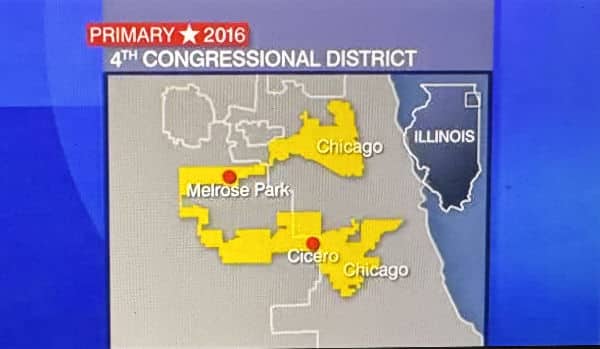
Lastly, who can forget Rep. Gutierrez’s district, shaped like a C, to become a Hispanic district? It is a great example of Illinois gerrymandering.
Luis Gutiérrez represented Illinois’s 4th congressional district, which was created to pack two majority-Hispanic areas into a single district. This design was intended to create a majority Hispanic district and has been noted for its gerrymandered nature. The district’s shape has been a topic of discussion, with some calling it one of the most heavily gerrymandered congressional districts in the country.
This is his former district: