

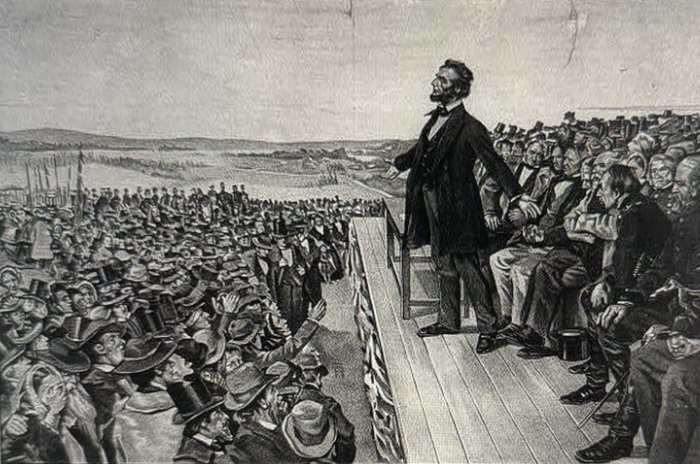
On this day, 163 years ago, the bloodiest battle of the Civil War became the turning point, and was to soon usher in the end of war and freedom for all the slaves.
Early in the morning on Gettysburg day 3, July 3rd, 1863, Union batteries from the XII Corps opened up on Confederate positions on lower Culp’s Hill. General Johnson was ordered to attack the Union positions at the top of Culp’s Hill, which had been reinforced overnight by units from the I and VI Corps and were significantly stronger than the day before.
Pickett’s Charge, one of the most futile and bloodiest assaults of the Civil War, left a three-quarter-mile trail of casualties across the open fields before the aptly named Cemetery Ridge.
The Turning Point in the Civil War: Pickett’s Charge
Despite having made significant inroads during sharp engagements on July 2, the Confederate army had failed to dislodge the main Union line occupying the high ground south of Gettysburg.
Initially, Lee planned to renew the previous day’s offensive with a second round of attacks on the federal flanks. Around dawn, however, Union artillery on Culp’s Hill began an intense bombardment aimed at retaking a portion of the defensive works on the lower slopes that had been lost in the previous night’s fighting. The Confederates attacked, but despite seven hours of fierce fighting, the Union line held firm.
When the Battle of Gettysburg ended, as many as 51,000 soldiers were killed, wounded, captured, or missing.
As Lee led his army on a torturous retreat back to Virginia, an extensive network of hospitals emerged to treat the injured, while local residents began the hard work of dealing with the dead and returning to normalcy.
Four months after the battle, President Lincoln used the dedication ceremony for Gettysburg’s Soldiers’ National Cemetery to honor the fallen Union soldiers and redefine the purpose of the war in his historic Gettysburg Address.
In just 272 words, Lincoln redefined the Civil War as a struggle for the nation’s founding principles of liberty and equality, urging Americans to dedicate themselves to ensuring that “government of the people, by the people, for the people, shall not perish from the earth”.
The Gettysburg Address
Four score and seven years ago, our fathers brought forth, on this continent, a new nation, conceived in Liberty, and dedicated to the proposition that all men are created equal.
Now we are engaged in a great civil war, testing whether that nation, or any nation so conceived, and so dedicated, can long endure. We met on a great battlefield of that war. We have come to dedicate a portion of that field, as a final resting-place for those who here gave their lives, that that nation might live. It is altogether fitting and proper that we should do this.
But, in a larger sense, we can not dedicate, we can not consecrate we can not hallow this ground. The brave men, living and dead, who struggled here, have consecrated it far above our poor power to add or detract. The world will little note, nor long remember what we say here, but it can never forget what they did here.
It is for us the living, rather, to be dedicated here to the unfinished work which they who fought here have thus far so nobly advanced. It is rather for us to be here dedicated to the great task remaining before us that from these honored dead we take increased devotion to that cause for which they here gave the last full measure of devotion – that we here highly resolve that these dead shall not have died in vain that this nation, under God, shall have a new birth of freedom, and that government of the people, by the people, for the people, shall not perish from the earth.
The Meaning of the War
The war was fought for the principles of freedom and to enshrine the principle that all men are created equal. Lincoln defined the war as one fought for a government of the people, by the people, and for the people. That is a government that shall not perish.
Every so often, even recently, a body or an artifact rises to the surface in those blood-drenched orchards.
You might not know that this was the turning point of the war. It was the victory that led to the freeing of the slaves.