

AI technology is driving a lot of fear, but anything new does. In the case of AI, if we don’t do it, our enemies will. And it can’t be stopped. Americans will accept it. We have a long history of risk-taking and innovation.
It might be a good time to review one piece of our history that drove fear and tremendous resistance. That is, America’s immediate rejection of the automobile, followed by its quick acceptance.
Americans replaced horses with cars because automobiles offered faster speeds, lower maintenance costs, and a solution to the severe urban sanitation crises caused by horse manure. However, it wasn’t without resistance. Cars weren’t forced on anyone. The free market chose them.
Cars were a much cleaner alternative. Horses excrete. In large cities, that meant thousands of tons of manure every day. Before the automobile, over 50% of the agricultural land in the USA was used to feed horses, not people.
Automobiles seemed a bad alternative at first. They were impractical toys for rich kids to speed around. They would pay for the injured or killed, but people tended to hate automobiles. Eventually, lobbyists invented jaywalking as a crime, making the victims the guilty parties.
At the time, people just walked the streets freely. Horses, cars, and pedestrians milled about without rules.
As technology improved, so did the image of automobiles.
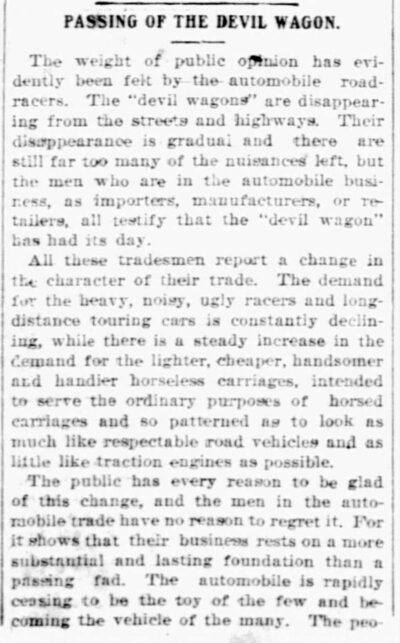
Touring and racing cars were called devil wagons.
The Touring Car
Creating roads and walkways for pedestrians wasn’t easy or cheap, but eventually, it all worked out. They shifted from horse-serving facilities — livery stables, barns, hay sellers, blacksmith shops, hitching posts, and the like — to auto-serving facilities, including fuel stations and repair shops.
German engineer Karl Benz invented the first practical, gasoline-powered car in 1885 and patented it in 1886.
While Karl Benz built the first modern automobile, the history of self-moving vehicles spans many years and involves several inventors.
The Tragic Story of One of the First Auto Salesmen
On March 3, 1902, The Daily Item reported the exact moment John L. Beightle introduced the first automobile to the town of Great Bend, Kansas.
The vehicle, an Oldsmobile, was a major novelty at the time. A follow-up report the next day in the Great Bend Beacon detailed a local journalist’s first experience riding in it:
“We rode over smooth roads at a rate over fifteen miles per hour, and we can truthfully say that it has fine traveling, not a jar or a jerk, but more like traveling upon smooth water than upon the hard roads…. They are far ahead of the horse and buggy…”
John L. Beightle was a local machinist, farmer, and salesman who sold threshing machines, bicycles, and firearms before becoming Great Bend’s first auto salesman.
Unlike many towns where early automobiles were met with hostility or fear of scaring horses, Great Bend residents adapted quickly. As a heavy farming community along the Santa Fe Railroad, locals were already used to coal-driven steam locomotives and large steam tractors.
Mr. Beightle’s story ended in tragedy.
Fifteen years later, in 1917, Beightle had become deranged and obsessed with jealousy. He had a mental breakdown. He sent his 12-year-old son to the shoe shop to have shoes repaired. He then shot his wife in the heart for being unfaithful, without evidence or cause. Leaving her dead on the kitchen floor, Beightle walked six blocks to the Elks Club downtown. Sitting on the club porch, he shot himself in the mouth.
His wife was reportedly well-respected, and the boy was a fine little chap who was heartbroken. There were a lot of holdings. The boy was cared for and his properties protected.
John L. Beightle died 27 Oct 1917 in Great Bend, Kansas. His body was taken to Olive Hill Cemetery, Soldier, Jackson County, Kansas, for burial. He was laid to rest by the side of his daughter.