

A New York Times report earlier this year cited a leaked document from Russian intelligence, revealing concerns about Chinese designs to expand its influence. The report highlighted a degree of mistrust on both sides, with Chinese agents said to be recruiting Russian nationals with Chinese spouses and conducting polygraph tests on returning agents returning from the Eurasian country.
Chinese territory was ceded to Russia in 1858 and 1860.
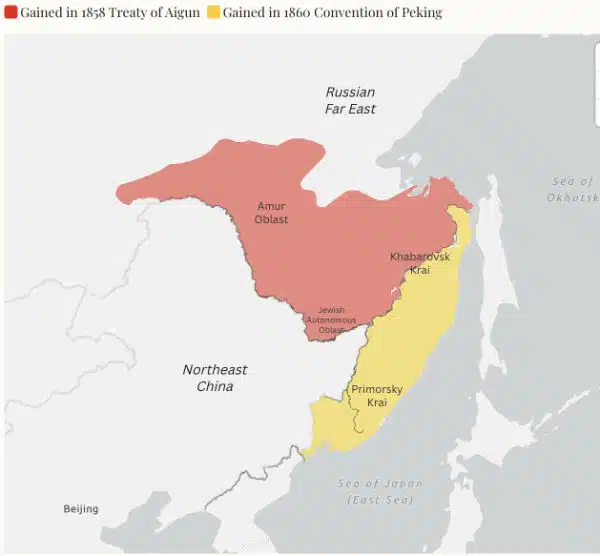
Those claims often cite the 1858 Treaty of Aigun. The report says Russia’s Tsar Alexander II forced China to sign. It transferred large parts of Manchuria to Russian control.
Although Moscow and Beijing have sought to reduce friction in recent years, territorial sensitivities have not disappeared, the report adds.
China’s nationalists want their land back.
“Xi Jinping views Russia as an indispensable strategic partner in constructing a post-U.S.–led world order,” Patrick Cronin, the Asia-Pacific security chair at the Hudson Institute, told Newsweek. “Reconciling these competing impulses points toward a strategy of slow, steady accretions of effective sovereignty, punctuated by performative shows of solidarity, from parades to joint military drills, that mask an emerging asymmetry.”
Cronin said, however, that China “clearly appears poised to expand its influence across its shared borderlands through a mix of brazen cyber intrusions and opportunistic moves to anchor itself inside Russia’s increasingly enfeebled economy.”
The territory is resource-heavy and lightly populated. Some voices in Beijing are framing it as a historic wrong waiting to be corrected.
The rhetoric comes even as Moscow and Beijing have publicly leaned into a closer relationship since Vladimir Putin’s full-scale invasion of Ukraine.
Nationalist commentators are calling for China to move on as much as a third of Russian territory if Russia suffers political and economic collapse.
The focus is the Russian Far East, a region spanning about 7 million square kilometres.
It is home to major mineral and energy resources, including gold, diamonds, and oil, yet has only around eight million residents compared with Russia’s population of roughly 143.5 million, according to the reporting.
For now, nothing will likely happen, but the future doesn’t bode well for Russia keeping the territory.
Russia never trusted China, but the Ukraine situation pulled them together since Putin sees NATO as an existential threat. For nor, they are inseparable.
China had better not screw with Russia as the Russians might well (if the mullahs are deposed in Iran) become perhaps China’s last source for crude oil.
Comments are closed.