

Beachy Head Lady is a skeleton discovered at Beachy Head, East Sussex, England, who lived between 129 and 311 A.D.
Beachy Head Lady was not a Black Roman as early DNA testing and measurements of the skeleton seemed to indicate. Myths grew around her after this young woman from the Roman era was discovered in a box. She was in the collections of Eastbourne Town Hall. No name. No written history. Only fragments of a life lived nearly two thousand years ago, and a mystery that grew larger the more people tried to explain her.
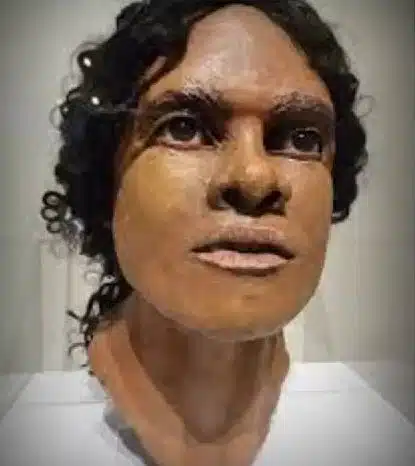
The mysterious woman, about 18 to 30 years old, died between 129 and 311 A.D. during the Roman occupation of Britain.
Her DNA now points to her having blonde hair, light eyes, and white skin. She had no trace of African ancestry. She stood about 4.9 and 5.2 feet tall. Isotope analysis showed she was born and grew up in the Anglo-Saxon area where she was found.
She was one of 300 sets of bones excavated from an Anglo-Saxon or Roman cemetery. Hers was the most complete skeleton.
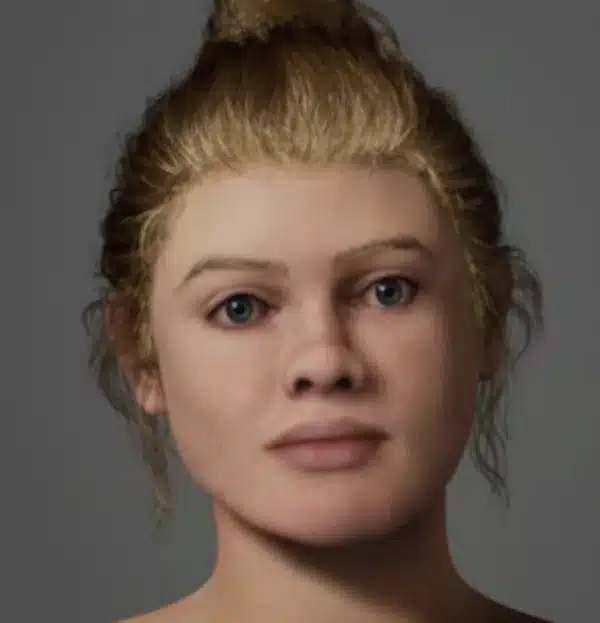
She had a serious injury to her leg that had healed. They also know she had a diet rich in seafood.
How Did She Die?
The cause of death remains undetermined, as no pathological lesions, perimortem injuries, or infectious processes were identified in the skeletal remains.
Ante-mortem trauma is evident, however, including an ossified hematoma on the midshaft of the right femur—suggesting a healed muscular or periosteal injury—and a unilateral malformation of the right jugular foramen, possibly trauma-induced and linked to potential hearing loss or neurological effects.
Dental evidence indicates ante-mortem stress, with cavities or tooth decay, calculus deposits, and enamel hypoplasia on several teeth, alongside congenitally absent third molars, but these reflect episodic childhood nutritional deficits rather than lethal conditions. Overall preservation allowed >75% recovery of skeletal elements, supporting the absence of acute fatal pathology.
Measurements Misled Archaeologists
In 2012, her remains were brought to light again and examined with morphometric analysis. The shapes and measurements of her bones led researchers to suggest that she may have originated from sub-Saharan Africa.
That conclusion transformed her from an archaeological individual into a cultural symbol. The idea of a woman from Africa living and dying in Roman-era Britain captured public imagination. It garnered much attention at the Eastbourne Museum. Her story seemed to speak of a far-reaching Roman world, one where people moved across continents.
However, science moves on, and advanced DNA technology told a different story. She descended from the local British population living in southern England during the Roman era. She was a white English girl.
In 2012 leftists were high on the Obama drug or maybe it was a temporary madness…
they saw blackness where there was none and saw white racists where there was none
only in recent months has this insanity begun to fade away, thanks in good part to Trump.
Thank you M Dowling, that was interesting, I did not know about this discovery.
but she was woke so still anti-male. as a good feminist she fell and broke her leg but blamed it on her boyfriend who had to give her his horse and all his winter wheat for five years. then she died.
“She was a white English girl.” (i.e., NOT A BLACK AFRICAN)
—NOW GUESS WHAT WILL HAPPEN TO ALL MENTIONS OF THIS WOMAN IN THE FAR-LEFT, LYING, BSing, LIBERAL, FAKE-NEWS “media” >>>
Comments are closed.