

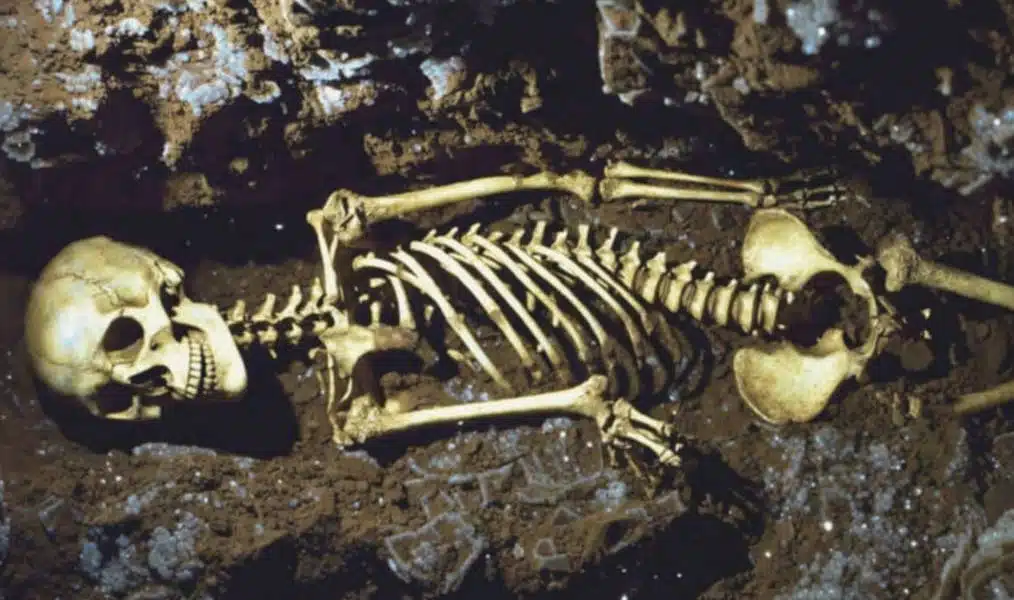
 A 4,500-year-old burial in Middle Egypt has reshaped what scientists know about ancient Egyptian origins. Inside a sealed limestone tomb near Beni Hasan, researchers uncovered the remains of a man whose DNA has become the oldest full human genome sequenced from Egypt’s Old Kingdom. The Pyramids weren’t completed during his time.
Buried in a Ceramic Plot
His skeleton, tucked inside a large ceramic pot, was found remarkably intact. Two of his molars held the key to a scientific first: retrieving complete ancient DNA from his civilization. The only one of his kind in that hot climate.
Instead of a strictly local ancestry, the man carried a surprising genetic mix—roughly 80% North African and 20% from the eastern Fertile Crescent, a region associated with ancient Mesopotamia.
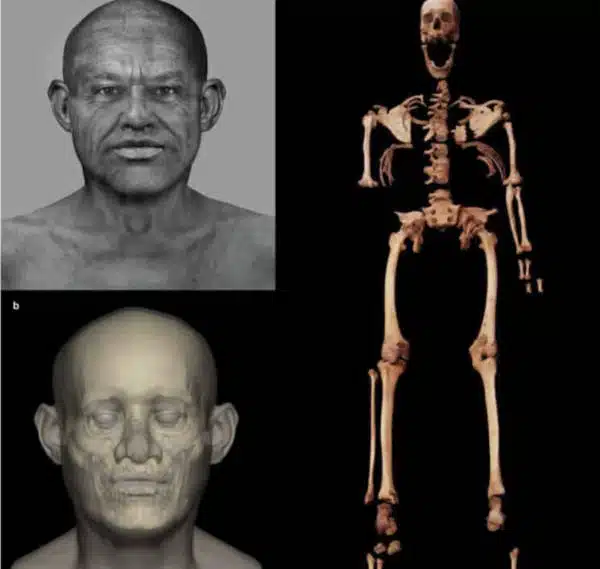
Researchers finally had proof that the civilizations were connected.
For decades, historians and archaeologists have noted similarities between Old Kingdom Egypt and Mesopotamia in artifacts, pottery, and early urban planning. But until now, physical evidence tying human migration to those links was missing.
This individual’s genetic makeup includes ancestry aligned with Neolithic North African populations—especially those from ancient Morocco—combined with traces linked to eastern Mesopotamian groups, part of the Fertile Crescent known for early agricultural development.
Linked to Mesopotamia
Earth.com reported that isotope analysis confirmed the man was raised in the Nile Valley, reinforcing the idea that his Mesopotamian-linked ancestry had entered the region generations earlier.
Although buried with care in a rock-cut tomb, the man’s skeleton revealed signs of chronic physical strain. Wear in the knees, hips, and arms indicated a lifetime of repetitive labor. These markers suggest he was likely an artisan, possibly a potter, based on skeletal stress typical of long hours seated at a wheel.
What’s unusual is the contrast between the physical toll on his body and the quality of his burial. Placement in a sealed pot inside a limestone tomb implies elevated social status—perhaps due to specialized skill or a role that earned him distinction beyond physical labor.
This mix of manual labor and elite burial complicates assumptions about class and work in early Egyptian society, hinting at a more nuanced social structure where specialized craft may have carried prestige.
WOW, such a ginormous discoverey! Imagine that, people walked from Mesopotamia to Egypt! How on earth did they ever do that?! (sarc), What a bunch of TOTAL MORONS to try to pretend that this holds some kind of significance. They must need GRANT MONEY for their welfare-financed archaeology projects, where they turn BS into some kind of significance and baffle the people with BULLSHITE.. Is this a UK site? That would make sense. UTTER STUPIDITY
Much speculation there. For all we know he might have been in the harem of the Pharaoh’s prostitutes. Has anyone checked obamas DNA?
Obama’s would reveal Malcolm X DNA.
Hey, don’t talk about my boy Malcom, he wanted to send “Them” back!
Comments are closed.