

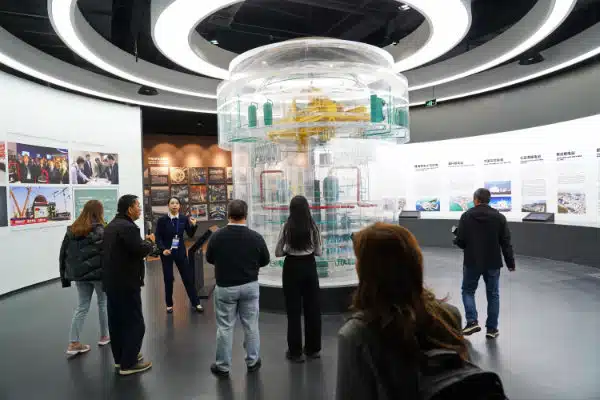
The United States and Japan have announced a major energy partnership, agreeing to invest $40 billion in building next-generation nuclear reactors across the American South. The plan was confirmed on Thursday after talks in Washington between US President Donald Trump and Japanese Prime Minister Sanae Takaichi. At the center of the deal are small modular reactors, or SMRs, to be developed in Tennessee and Alabama. The technology is being pitched as a more flexible, scalable alternative to traditional nuclear plants. This comes as Tokyo last year agreed to invest $550 billion through 2029 under a new trade pact with Washington.
It’s hard to believe the Japanese were ever our enemies.
SMRs have many advantages:
- Small Modular Reactors (SMRs) are compact, factory-fabricated nuclear reactors designed to produce up to 300 MW of electricity per unit, offering scalable, low-carbon energy solutions for diverse applications.
- Scalability: Multiple SMR modules can be added incrementally to match energy demand.
- Reduced footprint: SMRs require significantly less land than conventional reactors, making them suitable for remote or industrial locations.
- Lower costs and faster construction: Factory fabrication and modular assembly reduce on-site construction time and costs.
- Flexibility: SMRs can operate independently or be integrated into existing grids, and they are suitable for areas with limited grid capacity.
- Low-carbon energy: Like conventional nuclear plants, SMRs produce electricity without carbon emissions.
SMRs exist in Russia, China, and Japan. If you want clean energy, this is the way to go.