

Scott Adams 2017.png Copy
[[File:Scott Adams 2017.png|Scott_Adams_2017]]
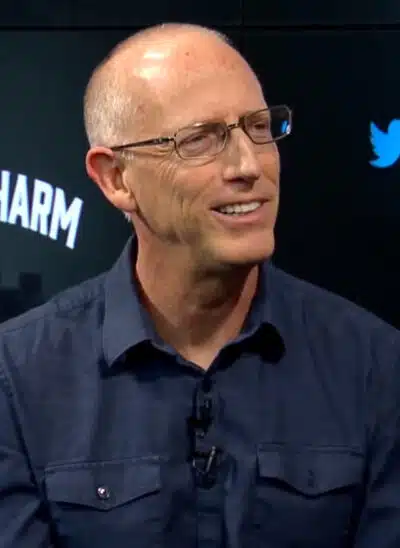
Cartoonist, author, and political commentator Scott Adams died Tuesday after a battle with prostate cancer. He was 68.
He lost everything over his support for President Trump, but he felt it was worth it.
From Scott Adams NYT obit: pic.twitter.com/PATUl0uI2U
— Ann Coulter (@AnnCoulter) January 13, 2026
His ex-wife and caregiver, Shelly, announced Adams’ passing on his livestream on Tuesday morning.
“Unfortunately, this isn’t good news,” Shelly said. “Of course, he waited ’til just before the show started, but he’s not with us anymore.”
Shelly read aloud a “final message” that Adams “wanted to say” on the livestream.
“If you’re reading this, things did not go well for me,” the message began. “I have a few things to say before I go. My body fell before my brain. I am of sound mind as i write this January 1, 2026.”
After speaking about Christianity, Adams’ message said, “For the first part of my life, I was focused on making myself a worthy husband and parent as a way to find meaning. That worked — but marriages don’t always last forever, and mine ended in a highly amicable way. I’m grateful for those years and the people I came to call my family.”
Adams announced he was diagnosed with metastatic prostate cancer in May 2025.
He said he had been dealing with his condition privately for some time before his public announcement, but noted that the cancer had progressed to Stage 4 and spread to his bones.
“I talked to my radiologist yesterday, and it’s all bad news — the odds of me recovering are essentially zero,” Adams said during his “Real Coffee with Scott Adams” podcast on Jan. 1. “I’ll give you any updates if that changes, but it won’t.
“So there’s no chance that I’ll get my feeling back in my legs, and I’ve got some ongoing heart failure, which is making it difficult to breathe sometimes during the day,” the iconic artist continued. “However, you should prepare yourself that January will probably be a month of transition, one way or another.”
On Monday, Shelly confirmed Adams was in hospice at his home in Northern California and had only a few days left to live.
Adams became famous through “Dilbert,” the comic strip that poked fun at corporate culture with keen insight into the absurdity, cruelty and incompetence of management inside large organizations.
In his last decade and a half, however, Adams achieved wide influence through his business advice and political analysis.
His 2013 bestseller, “How to Fail at Almost Everything and Still Win Big,” is one of the most influential and entertaining business books of recent years.
In it, Adams introduced the concept of using systems, rather than goals, to achieve success in life. He also advised readers to accumulate skills — a “talent stack” — rather than traditional credentials.
In 2015, Adams began commenting on politics after observing the first Republican presidential primary debate. When then-candidate Donald Trump responded to a moderator’s question that accused him of mistreating women by interjecting, “Only Rosie O’Donnell,” Adams took notice.
A trained hypnotist, Adams predicted that Trump, then a huge underdog, would win the nomination — and the presidency.
Adams drew ridicule for his bold claim. But he looked increasingly prescient as Trump dispensed with his opponents, the Republican establishment, and — eventually — Hillary Clinton.
Adams used what he called the “persuasion filter”: Rather than judging whether political rhetoric was true or false, he simply evaluated it based on whether it was persuasive.
What began as a simple blog post became a daily live video stream — first on the now-defunct Periscope platform, then on a variety of outlets, including anti-cancel-culture Rumble (in which he had invested).
Adams began each show by brewing fresh coffee; he eventually called his livestream “Coffee with Scott Adams,” and it became required viewing, or listening, for millions of fans, who poured their own mugs and tuned in at 10 a.m. ET for the “simultaneous sip.”
While he excelled at explaining Trump’s tactics to a growing audience of Trump-supporting fans, Adams was also interested in explaining how Democrats, and the left-leaning media, interpreted events.
He explained that the country was often watching “two movies on one screen,” and argued — with great empathy for his opponents — that voters who felt genuinely frightened by Trump’s ascent had been led into an emotional cul-de-sac by cynical leaders.
Adams emphasized that he was not a Republican: “I’m further left than Bernie Sanders,” he reminded viewers. He even endorsed Clinton in 2016 — for his own safety, he said. But he drew a conservative audience that soon included Trump’s own advisers.
In 2017, Adams published “Win Bigly: Persuasion in a World Where Facts Don’t Matter,” in which he extrapolated the lessons of Trump’s unlikely victory. He followed that with “Loserthink,” using his critiques of stale thinking in the media to teach positive mental habits.
During the coronavirus pandemic, Adams added an evening “swaddle,” in which he wrapped himself in a flannel blanket, and offered advice for surviving lockdowns. One of his ideas was a concept he called “the user interface for reality.” Given that we can only see reality through our own individual filters, he explained, we can choose which filter to use.
The “Dilbert” filter, for example, predicted incompetence; the Trump filter anticipated victory. By adopting filters that guide us toward success, Adams argued, we not only convince ourselves that success is possible, but bend reality toward that outcome.
While generally pro-Trump, Adams was critical of the president on occasion, and also took unexpected political stances. When then-San Francisco 49ers quarterback Colin Kaepernick began “taking a knee” for the national anthem in support of the fledgling Black Lives Matter (BLM) movement, Adams supported him, and admired the persuasive success of his protest. He even offered advice to leaders within BLM, notably New York’s Hawk Newsome.
In 2023, he was accused of racism when he commented on a Rasmussen poll in which only 53% of black respondents agreed with the statement: “It’s OK to be white.”
Adams quipped that it would be good to move away from people who felt that degree of hostility. He immediately found himself “canceled” — his comic strip dropped, his publishing contracts terminated.
He began self-publishing his books, including “Reframe Your Brain: The User Interface for Happiness and Success.” He relaunched an edgier version of “Dilbert” on the independent Locals platform, and felt liberated to express his more controversial political views — such as that the 2020 election had likely been “rigged,” given the increasingly evident corruption of nearly every other government system.
In the last weeks of his life, he posted on X, asking readers to share personal stories about how they had been affected by his teachings and podcasts. Adams shared intimate, and often painful, details of his life — losing a stepson to a fentanyl overdose in 2018, suffering through a second divorce in 2022, and fighting cancer.
He also embraced Christianity in his final days. While he would not divulge details about his faith, he confirmed his conversion in a final message that Shelly read on Tuesday’s livestream.
He reframed death, as he had reframed life: Just one more filter — and not one to fear.
People Magazine posted a nasty obituary.
With an obituary titled “Scott Adams, Disgraced Dilbert Creator, Dies at 68,” the outlet claims that Adams was racist.
The outlet supports their headline by saying that “Adams often weighed in on politics in his later years and endorsed President Donald Trump in the 2016 election. He was also opposed to the COVID-19 vaccine and masking, per PolitiFact. NPR reported in 2023 that he once questioned the death toll of the Holocaust.”





























I’m very thankful that Scott professed his faith in Christ, although I wouldn’t encourage anyone to wait until the last minute to accept Christ as your Savior, because we don’t know when that last minute will be. Ignoring the naysayers, I’ll trust that Scott was genuine in his faith and leave the rest up to Jesus. I have far more… Read more »